


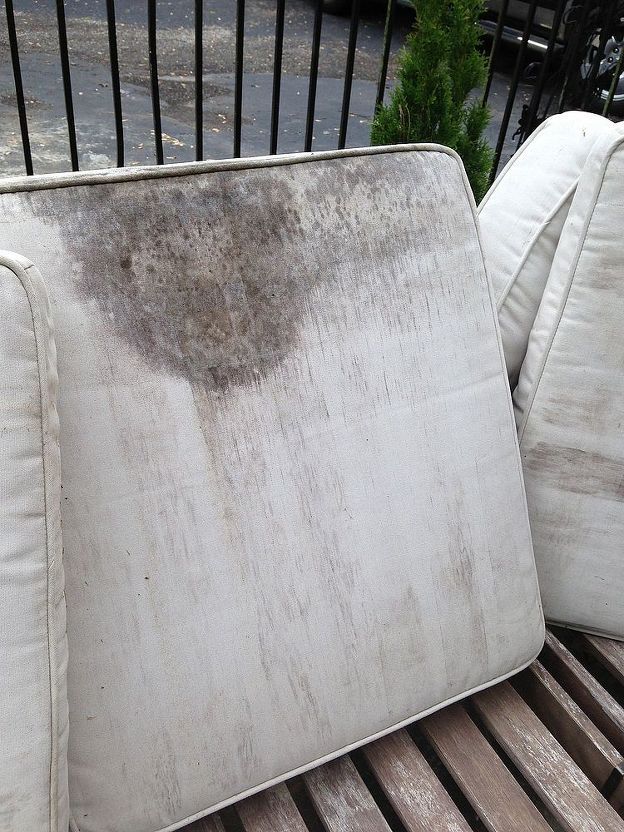
If your outdoor cushions are dirty, stained or covered with mildew, it can be tempting to think, “How hard can this be?” After all, they’re outdoor cushions. They get rained on. They sit in the sun. Surely a garden hose, pressure washer or some bleach should take care of them.
Well, sometimes it isn’t quite that simple.
After more than 55 years in the carpet and upholstery cleaning business, I’ve learned that cleaning fabric isn’t simply a matter of finding something that makes the dirt disappear. You have to understand what you’re cleaning, what you’re cleaning it with, how you’re applying it and what can happen if you get any of those things wrong.
Let me give you a few examples.
First, There’s the Garden Hose
The garden hose seems like a perfectly reasonable place to start.
You see dirt, dust and pollen on your outdoor cushions, so you drag out the hose and give them a good soaking. You may remove some loose surface soil, dust and pollen, and that’s certainly better than nothing.
But what about the dirt, stains and mildew that are actually embedded in the fabric?
A hose doesn’t provide the chemistry or mechanical action necessary to properly clean many of those contaminants. And there’s another issue: you’re adding a considerable amount of water to a cushion without necessarily removing everything that caused the problem in the first place.
If mildew is already present, simply adding more moisture isn’t necessarily the solution.
Then There’s the Pressure Washer
Now we have the homeowner who wants to be a little more aggressive.
He’s got a pressure washer sitting in the garage, and it does a terrific job cleaning his driveway. It cleans his deck. It cleans other outdoor surfaces.
So why not the cushions?
Well, there’s one small problem.
A driveway isn’t fabric.
A concrete driveway can take a tremendous amount of pressure. Many wooden or synthetic decking materials can tolerate considerable pressure as well.
Outdoor cushion fabric is a completely different material.
And when the stain doesn’t come out, the natural reaction can be, “I’ll just move the spray nozzle a little closer.”
That’s when things can go wrong very quickly.
The pressure that was cleaning the fabric a moment ago can suddenly become strong enough to damage it. You can distort the fabric, damage the fibers or, in some cases, actually put a hole right through the material.
Oops.
Then Comes the Bleach
Now we have the homeowner who knows a little more about cleaning.
He sees mildew and thinks, “I know what kills mildew. Bleach.”
And he’s right that chlorine bleach can be an effective tool for certain mildew-cleaning situations.
But the fact that bleach works doesn’t mean that more bleach works better.
One of the biggest mistakes I see is using a solution that is much stronger than necessary.
Many outdoor fabrics are made from solution-dyed polyester, which can be quite resistant to chemical exposure. But you can’t simply look at a cushion and know exactly what fiber or dye system you’re dealing with.
If the fabric is something else, the consequences of using bleach can be very different. You may end up removing color rather than removing mildew.
And even when the fabric can tolerate bleach, using a solution that is too strong can cause discoloration.
I’ve seen this many times.
One particularly frustrating problem is yellowing caused by an overly strong bleach solution. Once that happens, getting the yellowing back out isn’t necessarily a simple matter. Even for someone like me, with years of experience cleaning outdoor cushions, it can take several attempts with thorough extraction cleaning to correct the problem.
“But I Tested a Small Area!”
That’s a good start.
Actually, it’s an important start.
But testing isn’t simply about finding out whether a particular fabric “looks okay” after applying a cleaning solution.
After cleaning thousands and thousands of outdoor cushions, I’ve learned one thing very clearly:
You cannot always look at a fabric and know exactly what it is.
That’s why we test every fabric.
Testing helps us determine how that particular material and its dyes are going to react before we proceed with the entire cushion.
It may seem like an unnecessary extra step.
It’s not.
A few minutes of testing can potentially save someone from having to replace an entire set of expensive outdoor cushions.
There’s More to Bleach Than “Spray It On”
There are other things to understand when using a bleach solution.
For example, when we’re dealing with certain types of contamination, a properly selected detergent may be used with the cleaning solution to help it penetrate the material. It isn’t enough to simply put a chemical on the surface and hope it does its job.
Then there’s dwell time.
How long should the solution remain on the fabric?
That’s an important question.
You need to give the cleaning solution enough time to work, but you also don’t want to leave a chemical on a fabric indefinitely. The correct approach depends on the fabric, the soil and the cleaning chemistry being used.
And then there’s something else many people overlook:
Rinsing.
Think about it.
You wash your dishes and then rinse them.
You wash your clothes and then rinse them.
You wash your car and then rinse it.
Cleaning a fabric doesn’t necessarily end when the cleaning solution has done its job.
The material needs to be properly rinsed and extracted so that the cleaning solution, loosened soil and contaminants are removed.
And Please Be Careful About What You Mix With Bleach
This is extremely important.
Never assume that because two cleaning products are individually safe, they are safe to mix together.
Bleach should never be mixed with ammonia-containing products. Doing so can produce toxic chloramine gases.
Bleach also should never be mixed with acids, which can release chlorine gas.
These chemical reactions can create extremely dangerous fumes that can cause serious respiratory problems.
This is one of the reasons I don’t recommend experimenting with different household cleaning products on your outdoor cushions.
Cleaning chemistry is something you need to understand—not guess at.
And Mildew Isn’t the Only Thing on Your Cushions
Let’s say you’ve successfully dealt with the mildew.
Are you finished?
Not necessarily.
What about the bird droppings that landed on the cushion?
What about the tree sap that dripped onto it?
What about the suntan lotion that transferred from your skin?
These are all different types of contaminants, and they don’t necessarily respond to the same cleaning chemistry.
A bleach solution may be useful for one problem and completely inadequate for another.
That’s an important distinction.
There isn’t one magic cleaning solution that removes everything from an outdoor cushion.
So Why Do We Clean Outdoor Cushions in Our Plant?
This is exactly why we eventually developed a specialized outdoor cushion cleaning program at our plant.
We have a designated area where we can safely perform the cleaning process.
We can test the fabric.
We can determine what we’re dealing with.
We can select the appropriate cleaning agents.
We can control how those products are applied.
We can allow the cleaning solution the appropriate amount of time to work.
We can thoroughly rinse and extract the cushions.
And perhaps just as importantly, we can control the drying process.
Outdoor cushions can hold a surprising amount of water. Proper drying is an important part of the cleaning process, particularly when you’re dealing with cushions that have had mildew problems.
Once they’re completely cleaned and dried, we can wrap the cushions in plastic so they’re protected during the winter and ready to use when spring arrives.
What If You Don’t Have Room to Store Them?
That’s another problem many homeowners face.
Outdoor cushions take up a lot of room.
You may have a garage, but perhaps your car already occupies most of it. Maybe you have a basement, but you don’t want a basement full of cushions.
That’s why we also offer winter storage for outdoor cushions.
We clean them, dry them, wrap them and store them so you don’t have to find somewhere in your home to put them for several months.
Then, when outdoor living season returns, they’re ready to go.
So, What’s the Lesson?
I’m certainly not saying that homeowners should never clean their own outdoor cushions.
What I am saying is that outdoor cushions are fabrics, and fabrics require a little more thought than a driveway or a deck.
A garden hose may remove some surface dirt.
A pressure washer may seem like a great idea until the fabric says otherwise.
And bleach can be a useful cleaning tool when it is appropriate for the material and used correctly—but it isn’t simply a matter of making the solution stronger and spraying it on.
You need to know what you’re cleaning.
You need to know what you’re applying.
You need to know how much to apply.
You need to know how long to let it work.
You need to know how to rinse it.
And you need to know how to dry it.
After more than 55 years in this business, I’ve learned that knowing what to do is important. Knowing why you’re doing it is even more important.
And sometimes, the smartest thing a homeowner can do is put down the garden hose, step away from the pressure washer and leave the bleach on the shelf.
Let Alec’s Handle Your Outdoor Cushion Care & Winter Storage
Rather than risking high-pressure tearing, chemical discoloration, or spending your weekend wrestling heavy wet cushions, let us take care of them at our specialized plant.
We perform controlled in-plant washing, deep extraction rinsing, complete climate-controlled drying, and optional protective winter storage for homeowners across Greater Boston, MetroWest, the South Shore, and Cape Cod.
Ready to refresh your outdoor living space?
Learn more about our Outdoor Cushion Cleaning & Winter Storage Services or call us today at 781-871-1415 for a free estimate!
— Alec Houle
Alec’s Carpet & Upholstery Cleaning LLC
Serving the Greater Boston and South Shore area for more than 55 years