



Oriental rugs are often beautiful works of art, featuring intricate patterns and a variety of rich colors. But when it comes to cleaning these rugs, those beautiful colors can sometimes present a challenge.
Can the colors in an Oriental rug bleed during cleaning? Absolutely. And after 56 years in the carpet and upholstery cleaning business, I can tell you that understanding the dyes in a rug is just as important as understanding the fibers themselves.
Let’s take a closer look at why Oriental rug colors can bleed, how to test for unstable dyes, and what can be done to reduce the risk of color bleeding during cleaning.
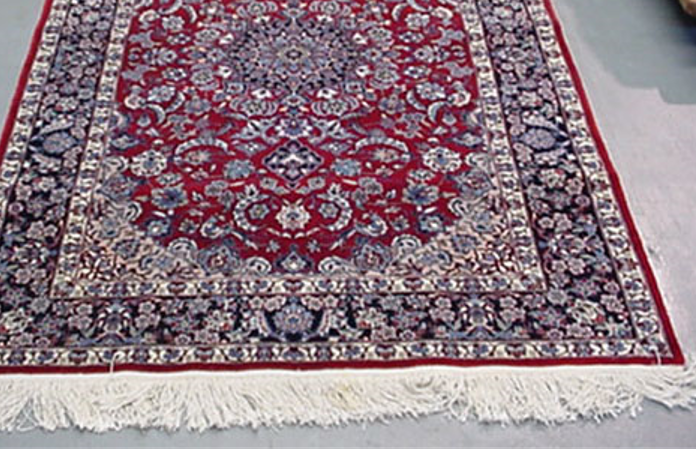
Why Can the Colors in an Oriental Rug Bleed?
Almost all Oriental rugs contain multiple colors. And here’s something important to understand: not all of those colors are necessarily equally stable.
Oriental rugs are made all over the world and are subject to many different types of dyes and dyeing processes. Although most of the dyes used in these rugs will bond to the fibers, particularly wool, the dyeing process can sometimes leave behind excess dye that has not bonded as securely as the dye initially applied to the fibers.
In my experience, I have encountered rugs where the initial dye has bonded reasonably well to the wool, yet excess dye can still transfer when the rug is exposed to moisture or agitation.
This is not necessarily something that can be determined just by looking at the rug. A rug can appear perfectly normal and still have colors that are susceptible to bleeding.
Always Test Each Color Before Cleaning
If you suspect that an Oriental rug may have unstable dyes, you should always test it before proceeding with cleaning.
And I don’t mean testing just one color.
You should test every color in the rug.
A simple way to do this is to use a damp white cloth. Place the cloth against each individual color for a minute or two, applying slight agitation.
Then examine the cloth to see whether any dye has transferred.
The white cloth makes it easier to identify dye transfer, particularly when dealing with darker colors such as reds, blues, and browns.
If one color transfers dye, that does not necessarily mean every color in the rug will bleed. Different dyes can have different levels of stability.
That is why testing each color is so important.
What Is Excess Dye, and Why Does It Matter?
Sometimes, more dye is applied during the manufacturing process than the fibers can securely hold.
I have encountered situations where the initial dye has bonded to the fibers, but some of the excess dye can be removed with a damp cloth.
This is similar to something that can occur with upholstery fabrics. When excess dye is present, a damp cloth may pick up some of that dye, even though the fabric itself has not necessarily lost all of its original color.
This type of dye transfer is sometimes referred to as crocking or dye transfer from rubbing.
The important thing to understand is that dye transfer can occur even when the rug has not been subjected to an aggressive cleaning process.
What If the Rug Really Needs Wet Cleaning?
Let’s say you are faced with an Oriental rug that is heavily soiled and has several spills or stains.
The rug may genuinely need wet cleaning to break down the accumulated soil and remove the staining.
But what happens when you are concerned about the possibility of color bleeding?
This is where the cleaning process becomes especially important.
There are several precautions that can help reduce the risk of dye migration.
1. Avoid excessively hot water
When dealing with a rug that may have unstable dyes, I would avoid using excessively hot water.
Warm water is generally a safer choice when trying to minimize the risk of dye bleeding.
The objective is to clean the rug effectively without unnecessarily increasing the risk of dye migration.
2. Avoid strong alkaline detergents
The cleaning agent you use is also important.
A strong alkaline detergent can destabilize certain dyes and increase the possibility of dye bleeding.
When cleaning a potentially unstable Oriental rug, I would avoid unnecessarily strong alkaline cleaning agents.
The cleaning solution should be selected with the rug’s fibers, dyes, and condition in mind.
3. Follow the cleaning with an acidic rinse
After the initial cleaning, I recommend following up with an appropriate acidic rinse.
The purpose is to help neutralize and remove residual alkalinity from the cleaning process.
This is particularly important when an alkaline cleaning agent has been used.
The rinse should be compatible with the rug and its dyes, and it should not be treated as a guarantee that unstable dyes will become colorfast.
4. Control the drying process
Once the cleaning is completed, the drying process becomes another important consideration.
I would use air blowers to circulate air around the rug and encourage drying.
The goal is to promote efficient drying without unnecessarily extending the time the rug remains wet.
The longer a rug remains wet, the more opportunity there may be for unstable dyes to migrate.
Proper drying is an important part of the overall cleaning process.
Can Sunlight and Pet Stains Cause Color Loss?
There is another important consideration when cleaning Oriental rugs.
Sometimes, the color loss that occurs during cleaning is not actually caused by the cleaning itself.
Certain areas of a rug may have been exposed to excessive sunlight over the years. Sunlight can break down dyes, leaving those areas more vulnerable to color loss.
When the rug is cleaned, the cleaning process may simply assist in removing dye that has already been weakened by prolonged sun exposure.
Pet stains can also present a similar problem.
Certain pet urine deposits can alter the chemical structure of dyes and damage the fibers themselves.
When a professional cleaner attempts to remove the pet stain, the damaged color may come out along with the stain.
This can be frustrating for a homeowner because the rug may appear to lose color during cleaning.
However, the underlying damage may have occurred long before the cleaning began.
This is one reason why it is important to distinguish between dye bleeding caused by the cleaning process and color loss caused by pre-existing damage.
The Bottom Line: Oriental Rug Cleaning Requires Experience
Oriental rugs are not all alike.
They are made in different countries, using different fibers, dyes, and manufacturing processes. Even two rugs that look similar may react very differently to cleaning.
That is why I believe testing each color before cleaning is so important.
When a rug is suspected of having unstable dyes, a professional cleaner needs to understand the potential risks and adjust the cleaning process accordingly.
Warm water, an appropriate cleaning agent, a suitable acidic rinse, and controlled drying can all help reduce the risk of dye bleeding.
But even with these precautions, there are times when a rug has pre-existing dye damage that cannot be corrected.
After 56 years in this business, I have learned that the best approach to Oriental rug cleaning is to understand the rug before you begin cleaning it.
And remember, the fact that a rug needs cleaning does not necessarily mean that every stain or discoloration can be safely removed without affecting the color.
Professional Area Rug Cleaning
Have an Oriental rug that needs cleaning? At Alec’s Carpet & Upholstery Cleaning LLC, we understand the importance of evaluating a rug’s fibers, dyes, and condition before cleaning.
With 56 years of experience, we take the time to understand each rug and select an appropriate cleaning method.
Learn more about our Professional Area Rug Cleaning Services and how we care for your area rugs.
Have a question about carpet cleaning, upholstery cleaning, or the care of your Oriental rugs? I have been answering questions and helping homeowners care for their furnishings for 56 years.
Visit Alec’s Carpet & Upholstery Cleaning LLC to learn more about professional carpet, upholstery, and area rug cleaning.