



Velvet furniture can be beautiful, luxurious, and comfortable. However, cleaning velvet upholstery requires more than simply removing the soil. If the fabric is not properly finished after cleaning, it can develop light and dark areas, streaks, or marks that make it look uneven.
After more than 56 years of experience in carpet and upholstery cleaning, I’ve learned that understanding how a fabric is constructed and how it responds to moisture is just as important as choosing the right cleaning method.
One of the most important things to understand about velvet is that cleaning the fabric and restoring its appearance are two different parts of the job.
First, Understand What Velvet Really Is
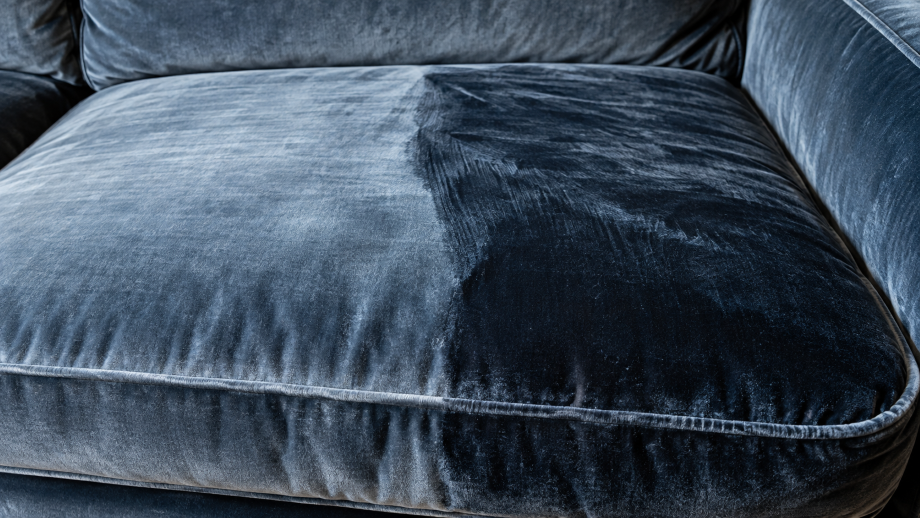
Velvet is not a fiber. It is a type of fabric construction in which short fibers form a raised surface, commonly called the pile. Depending on the fabric, that pile can reflect light differently depending on the direction in which the fibers lie.
Velvet can be made from many different fibers, including cotton, nylon, acrylic, wool, rayon, silk, and modern synthetic microfibers. Each has its own characteristics and may respond differently to moisture, heat, pressure, and cleaning.
This is important because you cannot assume that every velvet fabric should be cleaned in exactly the same way.
The cleaning method must be appropriate for the particular fabric. But with velvet, there is another consideration: what happens to the pile as the fabric dries?
Why Does Velvet Develop Light and Dark Marks After Cleaning?
Have you ever noticed that velvet can look lighter when you brush your hand in one direction and darker when you brush it in the opposite direction?
That is because the direction of the pile changes how light reflects from the surface. When the fibers lie in different directions, the fabric can appear to have stripes, patches, or uneven shading, even when it is perfectly clean.
Cleaning can disturb that pile. If the fibers are allowed to dry in different directions, the resulting appearance may be uneven.
Many natural-fiber fabrics are particularly sensitive to changes in moisture and drying conditions. Some can retain changes in shape or texture as they dry. The precise response depends on the fiber, the construction, and the fabric’s finish.
An analogy I use to explain this to customers
I sometimes compare velvet to human hair.
If you have long hair and wash it, then comb it straight while it is wet and allow it to dry, it will generally dry relatively straight. But if you put your hair in rollers while it is wet and let it dry before removing the rollers, it will tend to retain the curls.
The hair has dried in the position in which it was held.
Velvet can behave in a similar way. If its pile is left lying in different directions while it dries, the fabric can develop visible differences in shading and appearance.
That is why I don’t consider the job finished simply because the soil has been removed.
The Finishing Technique That Makes a Difference
When I clean velvet, I pay particular attention to setting the nap, which means arranging the pile so that it lies in a consistent direction.
Depending on the fabric and its condition, I may use a soft brush or a suitable damp cloth to groom the pile after cleaning.
With natural-fiber velvet, I often assist the drying process with a blower or hair dryer when appropriate for the material. Especially when spot cleaning a velvet cushion, I carefully dry the treated area while continuing to groom the fibers with a soft brush.
The objective is to help the cleaned area dry with a pile direction that matches the surrounding fabric.
This takes judgment. The amount of moisture, the temperature used during drying, the type of brush, and the pressure applied must all be appropriate for the particular velvet. Delicate fabrics can be damaged by excessive heat, friction, or moisture.
The technique is not simply to brush every velvet fabric in the same direction regardless of its construction. The goal is to achieve the most uniform appearance possible without damaging the material.
Proper finishing is an essential part of cleaning velvet upholstery.
Why Spot Cleaning Velvet Can Be Challenging
Spot cleaning can present a particular challenge when only one cushion or one small area of a velvet sofa is treated.
Even if the soil is successfully removed, the cleaned section may reflect light differently from the surrounding fabric because the pile has dried in a different direction.
The result can be a visible mark that looks like a stain, even though the original soil is gone.
When I spot clean velvet, I pay close attention to drying and grooming the treated area so that it blends with the rest of the fabric. The objective is to avoid leaving a noticeable difference between the cleaned section and the surrounding upholstery.
However, not every mark can be corrected simply by grooming the pile. Some changes are temporary, while others may involve permanent fiber or surface damage. In certain cases, treating a larger area may be necessary to achieve a more uniform appearance, and even then, a satisfactory result cannot be guaranteed.
This is one reason I believe a cleaner should evaluate the fabric before promising that a particular spot can be removed without leaving any visible evidence of the treatment.
Chenille and Corduroy Can Present Similar Challenges
Velvet is not the only upholstery fabric in which the direction or condition of the surface can affect its appearance. Chenille and corduroy can also present challenges, although their constructions and responses to cleaning differ.
Chenille upholstery
Chenille can be particularly sensitive to moisture, pressure, and handling, depending on its fiber content and construction. I have seen cases in which even ordinary contact has left a visible mark.
For example, a person resting a hand against the back of a chenille sofa for a period of time may leave a mark caused by the heat, moisture, pressure, or disturbance of the fabric surface. In some cases, these changes can be permanent.
Sometimes the only practical way to improve the overall appearance is to treat the entire surface and carefully finish it so that the fabric looks as uniform as possible. Spot cleaning alone may not accomplish that.
A lesson from a very large chenille sectional
I once worked with a customer who had purchased a very large chenille sectional that could comfortably seat approximately ten people. The furniture was only about a week old when she contacted me.
There were a few handprints on the upholstery, and then her father visited and accidentally spilled red wine on it.
I explained that I could work on removing the red wine, but I was concerned that cleaning only the affected cushion would leave it looking different from the other cushions. To achieve a more uniform appearance, I recommended cleaning the entire sectional.
She decided to have the whole sectional cleaned.
Afterward, she contacted the furniture retailer and ultimately returned the sectional because she found the fabric’s maintenance requirements unacceptable.
That experience illustrates an important point: a fabric may look wonderful in a showroom but require more care than a homeowner is prepared to provide.
Corduroy upholstery
Corduroy has raised parallel ribs that can show changes in appearance when the surface is compressed, disturbed, or cleaned unevenly.
As with velvet and chenille, the cleaner needs to understand the construction of the fabric and how it may look after treatment and drying. A method that works well on an ordinary woven upholstery fabric may not produce the same visual result on a fabric with a raised or textured surface.
What Should You Know Before Having Velvet or Chenille Cleaned?
If you own furniture upholstered in velvet, chenille, or another delicate fabric, here are a few things I recommend considering before arranging professional cleaning.
- Identify the fabric. Fiber content, construction, and manufacturer care instructions all matter.
- Have the fabric assessed before cleaning. The cleaner should consider dye stability, texture, condition, and the potential for changes in appearance.
- Understand the risks of spot cleaning. Removing a stain does not guarantee that the treated area will look identical to the surrounding fabric.
- Ask about finishing and drying. With pile fabrics, the process used after soil removal can be just as important as the cleaning itself.
- Consider maintenance before buying furniture. Some fabrics require more careful handling and may be less forgiving of spills and everyday contact than others.
A professional cleaner should explain these considerations before proceeding, particularly when a fabric is delicate or the desired result cannot be guaranteed.
Final Thoughts From Alec
After more than 56 years in this business, I have learned that successful upholstery cleaning involves much more than choosing a cleaning solution and removing the soil.
The cleaner must understand the material, anticipate how it will respond to treatment, and consider how it will look after it dries.
With velvet, the finishing technique can be critical. With some chenille fabrics, even a small amount of moisture or ordinary contact can cause changes in appearance. And with textured fabrics such as corduroy, the surface construction introduces its own challenges.
Sometimes the best advice is to proceed carefully, explain the risks, and make sure the customer understands what is realistically achievable before the cleaning begins.
That is the kind of advice I believe homeowners deserve.
Have a question about your upholstery?
If you have velvet, chenille, or another delicate upholstery fabric that needs attention, I encourage you to ask questions before attempting to clean it yourself or arranging professional cleaning.
At Alec’s Carpet & Upholstery Cleaning LLC, I believe in evaluating the fabric and explaining the options honestly.
Call Alec’s at 781-871-1415 to discuss your upholstery cleaning needs.
You can also visit our Upholstery Cleaning page to learn more about our services, or browse the Ask Alec series for more practical advice about caring for carpets, upholstery, and area rugs.