


After 56 years in the carpet and upholstery cleaning business, I’ve learned that one of the biggest mistakes homeowners make is assuming that if a little stain remover is good, more must be better.
Unfortunately, it doesn’t work that way.
Different stains require different cleaning chemistry. Some products are designed to break down oils. Others are formulated for protein-based stains, tannins, dyes, food, or pet urine. Once the appropriate product has been applied, it may need to be agitated or blotted, depending on the type of stain, and then rinsed and extracted from the carpet.
Simply spraying something on a stain and leaving it there doesn’t mean the stain has disappeared.
In fact, you can sometimes turn a relatively simple cleaning problem into a much more complicated one.
Breaking Down a Stain Isn’t the Same as Removing It
Think about washing your hair.
You wet your hair, apply shampoo, work it into your hair, and then rinse it out.
Imagine if you never rinsed the shampoo out.
The same basic principle applies to cleaning a carpet.
A cleaning product may be designed to break down or loosen the material causing a stain. But once the product has done its job, the loosened material and the cleaning solution still need to be removed.
That’s why professional carpet cleaning involves more than simply applying a chemical.
The goal isn’t just to break down the stain. The goal is to remove what caused the stain and the cleaning products used to treat it.
The Problem With Trying One Product After Another
I have seen homeowners treat a stain with one product, decide it isn’t working, and then reach for another.
Then another.
Eventually, there may be several different cleaning products sitting in the carpet.
That’s particularly concerning because different cleaning products are not necessarily compatible with one another. Some combinations can affect carpet fibers, dyes, or other components of the carpet.
And even if no visible damage occurs, you may have created a carpet containing multiple layers of cleaning-product residue.
That’s not necessarily something a homeowner can simply vacuum away.
A Pet “Accident” That Happened Every Week
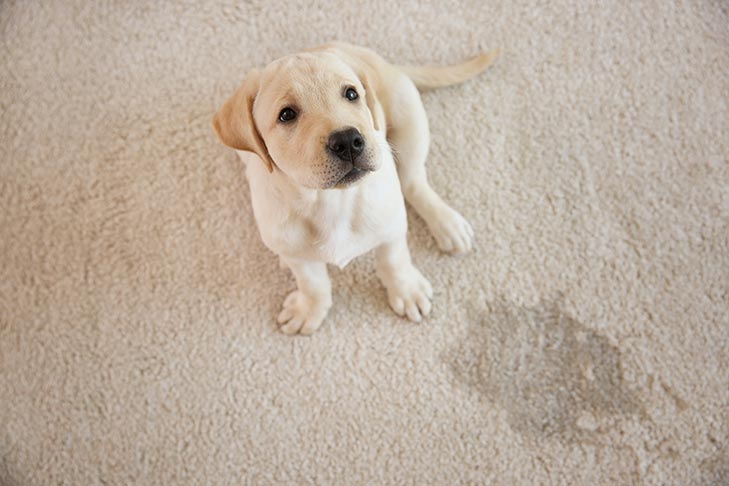
I remember one high-end client in Brookline whom I had serviced for many years. She had two small dogs, and they had what she called “accidents.”
There was one problem with that description.
The accidents seemed to happen almost every week.
One day, she showed me a urine stain in the den. I asked her what she had done to the spot.
“Nothing,” she said.
That was actually good news. If a customer tells me that a pet has just urinated on the carpet and they haven’t put anything on it, I would much rather work with that than a spot that has already been treated with several different products.
Then I noticed something on a shelf in the room.
There were four or five different pet-stain-removing products sitting there.
I didn’t confront her about it. But I had a pretty good idea what had probably happened with some of those stains over the years.
And this is something I have encountered many times.
The homeowner sees a stain.
They spray something on it.
It doesn’t disappear.
So they spray something else on it.
Eventually, the carpet may contain more cleaning products than anyone realizes.
What Should You Do When Your Pet Has Just Urinated on the Carpet?
If the urine is still wet, the first thing you want to do is remove as much of it as possible without pushing it deeper into the carpet.
This is what we have traditionally told customers who call our office after a fresh accident.
First, take clean white paper towels and lightly blot the area.
Don’t scrub.
After you’ve removed what you can with light blotting, blot again using a little more pressure.
Then increase the pressure again.
You can even put several layers of paper towels over the area and stand on them.
The idea is to gradually draw the urine out rather than forcing it deeper into the carpet.
Continue until you aren’t getting much more moisture.
Then take a clean white cloth, wet it with warm water, and blot the area. The purpose of this step is to dilute some of the urine that remains.
Then go back to the dry paper towels and blot again.
In simple terms:
Absorb → dilute → absorb.
And then, if you are planning to have the carpet professionally cleaned, leave it alone.
There is usually no reason to keep adding chemicals before we arrive.
Why Pet Urine Can Be Particularly Difficult
Pet urine presents a problem that many homeowners don’t realize.
Urine doesn’t necessarily stay in the carpet fibers you can see.
It can penetrate through the carpet and into the backing and, in some situations, into the padding underneath.
As urine dries, it can leave behind uric-acid salts and other residues.
These residues can be difficult to remove, particularly when they have penetrated deeply into the carpet.
They can also contribute to a recurring odor problem.
One reason people sometimes notice that a urine odor seems to “come back” during hot, humid weather is that these residues can attract moisture from the air. When the humidity rises, the remaining residue can become active again and produce that familiar ammonia-like odor.
So the homeowner may think:
“The smell was gone. Why is it back?”
The answer can be that the source of the odor was never completely removed.
Sometimes the Urine Is in the Backing
This creates another problem for the professional cleaner.
You want to remove the contamination.
But you also don’t want to damage the carpet while trying to remove it.
Many carpets contain backing materials that can be sensitive to excessive moisture. Some backings contain jute or cotton, which can shrink if they become too wet.
When the backing shrinks, the carpet can buckle or develop other distortions.
Wilton-weave carpets are one example where this can require particular care.
These carpets are popular in higher-end homes, and because they are often relatively short-pile carpets, there may be only about a quarter of an inch between the surface of the carpet and its backing.
That means there isn’t a lot of room for error.
You need enough moisture and flushing to address the contamination, but you don’t want to overwet the carpet.
You’re sometimes caught between a rock and a hard place.
You want to remove the urine and odor, but you don’t want to create a moisture-related carpet problem in the process.
That’s where experience matters.
And Then There Is Jute
Jute backing presents another potential problem.
If a carpet containing jute becomes too wet, the jute can release a yellowish or brownish substance that can wick upward into the carpet fibers as the carpet dries.
On some synthetic carpets, this may be manageable.
But if you’re dealing with wool or viscose, the situation can become considerably more difficult.
Now you’re no longer simply dealing with the original stain.
You may have created a browning or color-related problem as well.
This is one reason I don’t believe carpet cleaning should be approached as simply putting a product on a spot and hoping for the best.
You need to know what you’re working with.
What Kind of Fiber Is the Carpet?
Before treating a stain, a professional cleaner should consider what the carpet is made of.
Is it nylon?
Polyester?
Wool?
Viscose?
Something else?
The same cleaning procedure that is perfectly appropriate for one fiber may not be appropriate for another.
Then there is the backing.
What is it made of?
How is the carpet constructed?
How much moisture can safely be used?
What is the stain?
What cleaning chemistry is appropriate?
What product has already been applied?
And, perhaps most importantly, how are you going to remove everything after you’ve treated it?
These are questions homeowners generally don’t have the experience or equipment to answer.
Having the Right Equipment Matters Too
I’ve actually bought some of the best consumer spot-cleaning machines I could find for my own home in Florida.
I wanted to see what they could do.
My conclusion?
They were essentially useless for the type of extraction I was looking for.
I used each of them once and never used them again.
That’s not necessarily a criticism of the machines. They are designed for consumers and for limited spot cleaning.
But there’s a big difference between running a small portable spot cleaner over a stain and having professional equipment designed to thoroughly rinse and extract a carpet.
Applying the cleaning solution is only half the job.
You need to be able to remove it.
What We Do Professionally
When we professionally treat a urine-contaminated area, we’re looking at more than just the appearance of the stain.
We want to address the contamination and odor while protecting the carpet.
Depending on the carpet, fiber, backing, and severity of the problem, our process may include an acidic rinse to help remove remaining residues, followed by an enzyme treatment designed to break down the organic material associated with urine.
We allow the enzyme treatment sufficient dwell time to work—often in the neighborhood of 10 to 15 minutes, depending on the circumstances.
We then rinse and extract again.
But there isn’t one magic formula that works on every carpet.
The carpet itself determines what can safely be done.
That’s where 56 years of experience makes a difference.
My Advice? Don’t Ask Facebook
I see a lot of homeowners asking their Facebook friends what they should put on a carpet stain.
And I understand why.
They’re trying to help.
But the person giving the advice can’t see your carpet.
They don’t know what fiber it is.
They don’t know what the backing is made of.
They don’t know what cleaning product has already been applied.
They don’t know whether the carpet is wool, viscose, nylon, polyester, or something else.
And they certainly don’t know how wet the carpet can safely become.
Someone may tell you, “Try this. It worked great on my carpet.”
That doesn’t mean it will work on yours.
Sometimes the Best Thing You Can Put on a Carpet Is Nothing
If you have a fresh pet accident, blot it.
Remove as much moisture as you can without pushing it deeper.
If appropriate, dilute the remaining urine with a little clean warm water and blot again.
Then stop.
If you’re going to have the carpet professionally cleaned, call us and let us determine what the carpet needs.
After 56 years in this business, I’ve learned that cleaning a carpet isn’t simply about finding the strongest product you can buy.
It’s about knowing what you’re cleaning, what you’re cleaning it with, how much moisture you can safely use, and how you’re going to remove everything afterward.
Because sometimes, the attempt to fix a stain can create a much bigger problem than the stain itself.
Have a carpet-cleaning question for Alec?
Send us your question. After 56 years in the business, I’ve probably seen it before. You can always use our contact us page.
Learn more about our Professional Carpet Cleaning Services or call us directly at 781-871-1415 to discuss your carpet care needs with Alec!