



After more than 56 years in the carpet and upholstery cleaning business, I’ve learned that a dark stain on upholstery isn’t always as straightforward as it looks. Sometimes, the visible soil is only part of the problem. The condition of the fabric underneath can be just as important.
Two situations I’ve encountered over the years illustrate why these stains require special care: discoloration caused by skin oils and perspiration, and color transfer caused by hair dye. Both can create problems that are much more difficult to correct than homeowners might expect.
1. Dark Stains From Hair Oils, Skin Oils, and Perspiration
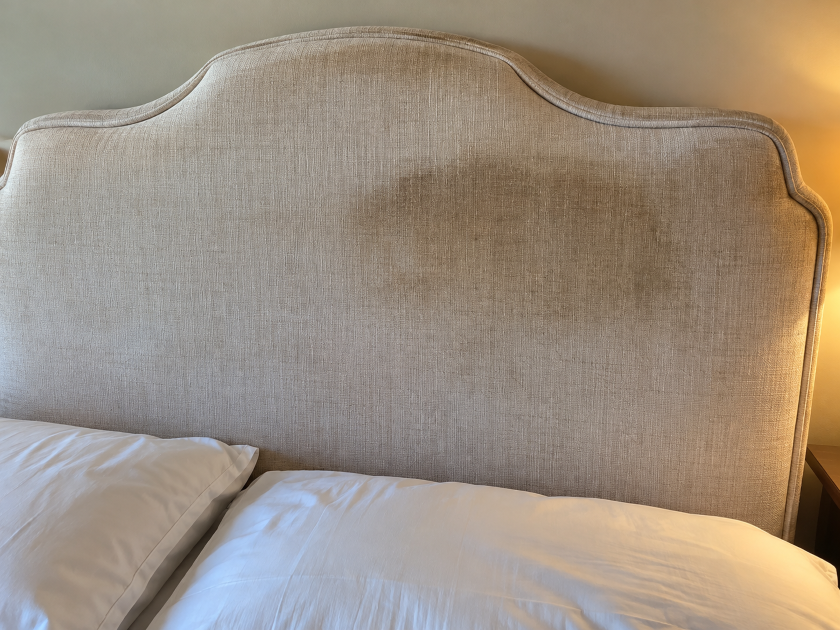
One of the more common problems I encounter is a darkened area on the back cushions of upholstered furniture or on a fabric-covered headboard. These stains often develop gradually from repeated contact with the head, neck, and skin.
When I visit a customer’s home and am shown an upholstered headboard with an oval-shaped stain where someone’s head rests, I’ve often observed that the stain is on the side of the bed where the man sleeps.
One possible explanation is that shorter hairstyles may allow more direct contact between the neck and the upholstery. However, hair length alone doesn’t determine how much oil or perspiration transfers to a fabric.
Over time, skin oils, hair products, and perspiration can accumulate on the fabric, attracting and retaining soil. This buildup can make the affected area appear progressively darker and dirtier than the surrounding material.
But the discoloration isn’t necessarily the most serious concern.
Perspiration contains salts, and repeated exposure to perspiration, moisture, and other contaminants can contribute to the deterioration of certain textile fibers. Cotton and other cellulosic fibers can be particularly vulnerable under unfavorable conditions.
As a result, a fabric that appears merely dirty may actually have weakened considerably.
Why ordinary cleaning can cause a problem
Someone might assume that applying a prespray, agitating the fabric, and then extracting or rinsing it will remove the stain. Sometimes, this approach will improve the appearance considerably. But when the fibers have already deteriorated, even relatively gentle cleaning can cause the fabric to tear.
I’ve always been aware of this potential problem, so when I encounter a heavily discolored headboard or cushion, I explain to the customer that I must be extremely gentle. There is no reliable way to determine the full extent of the fiber damage simply by looking at the stain.
In these situations, the top layer of accumulated soil may come off, improving the appearance. However, cleaning can also reveal a yellowish discoloration from body oils that have penetrated the fabric. That remaining discoloration may not be removable without risking further damage.
My advice is simple: Don’t assume that a darkened area is just a cleaning problem. The fabric’s condition must be considered before deciding how to treat it.
Sometimes, protecting the fabric is more important than pursuing complete stain removal.
2. Hair Dye Transferred to Upholstery
Another problem I’ve encountered is color transfer from men’s hair dye.
Some men apply hair-coloring products at home, and the color can transfer to upholstered headboards, furniture backs, or other fabrics that come into contact with their hair. This can happen through direct contact or when residual color rubs off onto the material.
Unlike ordinary soil or body oils, hair dye presents a different challenge because it is designed to impart color. Once the color has bonded to or penetrated the upholstery fibers, removing it can be extremely difficult.
In my experience, these stains often have a permanent effect on the fabric, and complete removal may not be possible. The outcome depends on the particular dye, the upholstery fiber, the fabric’s original color and finish, and how long the transferred color has been present.
Trying to remove the dye with increasingly aggressive chemicals can create another problem: the treatment may affect the original fabric color or damage the fibers without completely removing the transferred color.
This is why I caution against experimenting with household stain removers or strong chemicals. Before attempting any treatment, the fabric and the nature of the stain must be evaluated carefully.
3. A Simple Way to Protect an Upholstered Headboard
Over the years, I’ve also made a practical suggestion to customers and the many interior designers I work with to help prevent this type of problem before it starts.
If you’re having an upholstered headboard made, consider asking your upholsterer to provide an extra piece of matching fabric, approximately 24 by 24 inches. This piece can be attached with Velcro to the upper backside of the headboard, where it remains out of sight when not in use.
When you sit up in bed to read or relax against the headboard, simply flip the protective piece over the top so that it covers the front where your head and neck make contact with the fabric.
The removable piece takes the brunt of the oils, perspiration, and everyday soiling instead of the headboard itself.
In the morning, when making the bed, flip the protective piece back over to the rear of the headboard, keeping it out of sight.
Another advantage is that the protective piece can be removed for laundering, provided the fabric and its construction are suitable for washing.
Ideally, the protective piece should be made from the same upholstery material so that it blends in when in use. The care instructions should also be checked before washing to avoid shrinkage, color bleeding, or changes in texture.
It’s a simple, practical precaution that can help preserve the appearance of an upholstered headboard for years.
As I often tell customers and interior designers, preventing a stain and protecting the fabric is much easier than trying to correct a problem after the damage has occurred.
What Should You Do If You Find These Stains?
If you notice a darkened headboard, cushion, or upholstered backrest, avoid aggressive rubbing and don’t assume that stronger cleaning will produce a better result.
The safest approach is to identify the fabric, assess its condition, and determine whether the discoloration is primarily accumulated soil, permanent staining, or a sign of deterioration. Any proposed treatment should be tested in an inconspicuous area when appropriate, although testing must be approached cautiously if the fabric appears weakened.
Professional cleaning can often improve the appearance of oily soil, but it cannot restore fibers that have deteriorated or guarantee the removal of transferred hair dye.
After more than 56 years in this business, I’ve learned that knowing when to clean gently—and when to explain the limitations—is just as important as knowing how to remove a stain.
Sometimes the most responsible cleaning decision is to protect the fabric rather than pursue complete stain removal.
If you have questions about caring for your upholstered furniture, or you’re concerned about a stain that doesn’t respond to ordinary cleaning, feel free to contact Alec’s Carpet & Upholstery Cleaning. I’m always happy to share what I’ve learned about caring for carpets, upholstery, and fine fabrics over the years.
If you need professional upholstery cleaning or have questions about caring for your upholstered furniture, visit our Upholstery Cleaning page to learn more about our services. You can also contact us with your questions. With more than 56 years of experience, I’m happy to share my knowledge and help you make informed decisions about caring for your upholstery.